A coding agent can prepare an implementation, add tests and describe a change. Your team still has to decide whether the change solves the right problem, fits the architecture and can safely reach users. These decisions deserve attention before AI use expands across more projects.
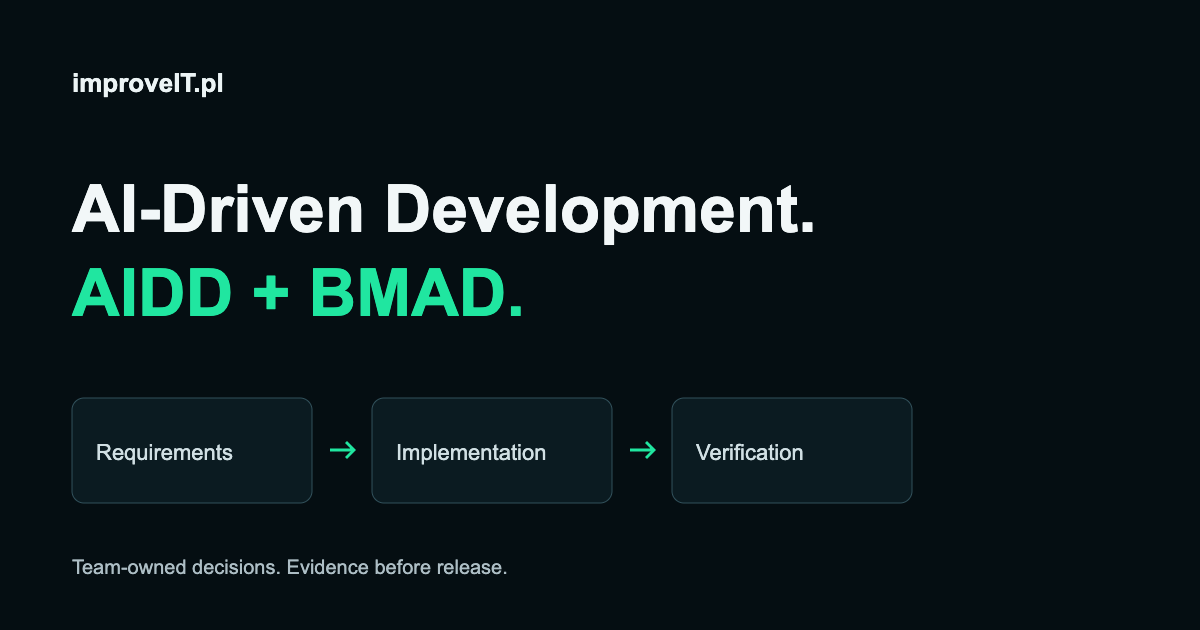
AIDD and BMAD operate at different levels. In the approach described here, AIDD organizes responsibilities, repository context, permission boundaries and verification. BMAD provides workflows supporting analysis, requirements, planning and implementation. Together, they should give the team a practical delivery process that can be evaluated on a real task.
Start with human responsibilities
The product owner defines the goal and acceptance criteria. Technical owners approve significant architecture decisions and accept residual risk. An agent can investigate, propose an approach, implement agreed scope and run permitted checks. Its completion report is not evidence of correctness on its own.
Record who can accept a change, which operations require additional approval and how a release happens. Policies should match actual tool permissions. A written instruction helps an agent but does not replace access controls, branch protection or environment restrictions.
Keep project context useful and current
Start with the application’s purpose, structure, test commands, important constraints and data responsibilities. Select context relevant to the affected area instead of loading all documentation into every task. Outdated instructions can send an agent toward the wrong interface or an obsolete command.
Keep durable decisions with the project and review them like code. Separate team policy from vendor-owned workflow files. Updating a supporting workflow should not silently overwrite security policies or release instructions.
How much planning does this change need?
Not every task needs a full requirements document or new architecture. A small fix following an established pattern may need concise acceptance criteria and a focused test. A cross-system integration needs explicit contracts, failure handling, compatibility decisions and a rollout approach. BMAD documents how to select an appropriate planning scope, rather than requiring the same document set for every task.
Choose tools and workflow versions your team can maintain during the pilot. Record the decisions and verify integrations. Command names and capabilities may change between releases; the team’s process should not depend on instructions remembered from a different version.
Example: connecting orders to an existing application
Suppose an application must send approved orders to an external system. This is an illustrative scenario, not a completed customer project. “Add the integration” leaves too many implementation decisions open. Define when an order is sent, which fields are required, what happens when the receiver is unavailable and how retries work.
| Area | Decision | Verification |
|---|---|---|
| Requirements | Only approved orders are sent | Positive tests and rejection of other states |
| Contract | Field mapping, API version and failure handling | Contract tests and invalid responses |
| Retries | Duplicate detection and state reconciliation | Loss of a response after a successful write |
| Security | Least privilege and secret protection | Permission and log review |
| Release | Approval owner, monitoring and rollback | Readiness check before activation |
The agent receives a bounded piece of work and criteria that can be evaluated. The team checks failure behavior as well as the happy path. If the external API supports idempotency keys, use them according to its contract; a task queue alone does not guarantee a single business effect. See our systems integration service for related engineering work.
Tests and reviews remain separate checks
A passing test matters when it checks an important condition. A test repeating the flawed implementation’s assumption can create false confidence. Review the criteria, edge cases and existing consumers. Automated review can find issues, but a second agent is not automatically an independent auditor.
Compare the output with the requirements and actual code. Retain executed check results, known limitations and the approver’s decision. GitHub’s guidance on reviewing AI-generated code also emphasizes verification before accepting generated output.
How do you assess whether a pilot helps?
Record a baseline and measurement method before starting. Observe delivery time, review time, corrections after review, post-release defects and model and tool costs. Compare tasks of similar difficulty. Completing one simple task faster does not justify forecasting savings for the entire product.
- Separate waiting time from active human effort.
- Include context preparation and output verification.
- Record situations requiring human intervention.
- Check whether someone outside the pilot can understand the resulting process.
Choose a task with a verifiable outcome
A useful pilot has bounded scope, a decision owner and an observable result. Afterwards, the team should be able to explain what worked, which rules need adjustment and whether broader AI use is justified. Greater autonomy should follow evidence and controls, rather than the mere availability of another executable command.
improveIT helps teams adopt AIDD + BMAD, from repository discovery to a pilot and process handover. If your goal is AI behavior inside the product, explore AI transformation. Ongoing development and observation can be combined with application maintenance.