Field service application
Job lists, issue photos, checklists, customer signatures and visit reports. Records can be saved offline and synchronized with CRM or ERP once connectivity returns.
Services
We build iOS and Android applications from product discovery and UX design through MVP delivery, backend integration, store publication and continued development. We tailor the experience to phones and tablets, including offline work, camera access, notifications and data security. AI features are added where they help users complete a concrete task.
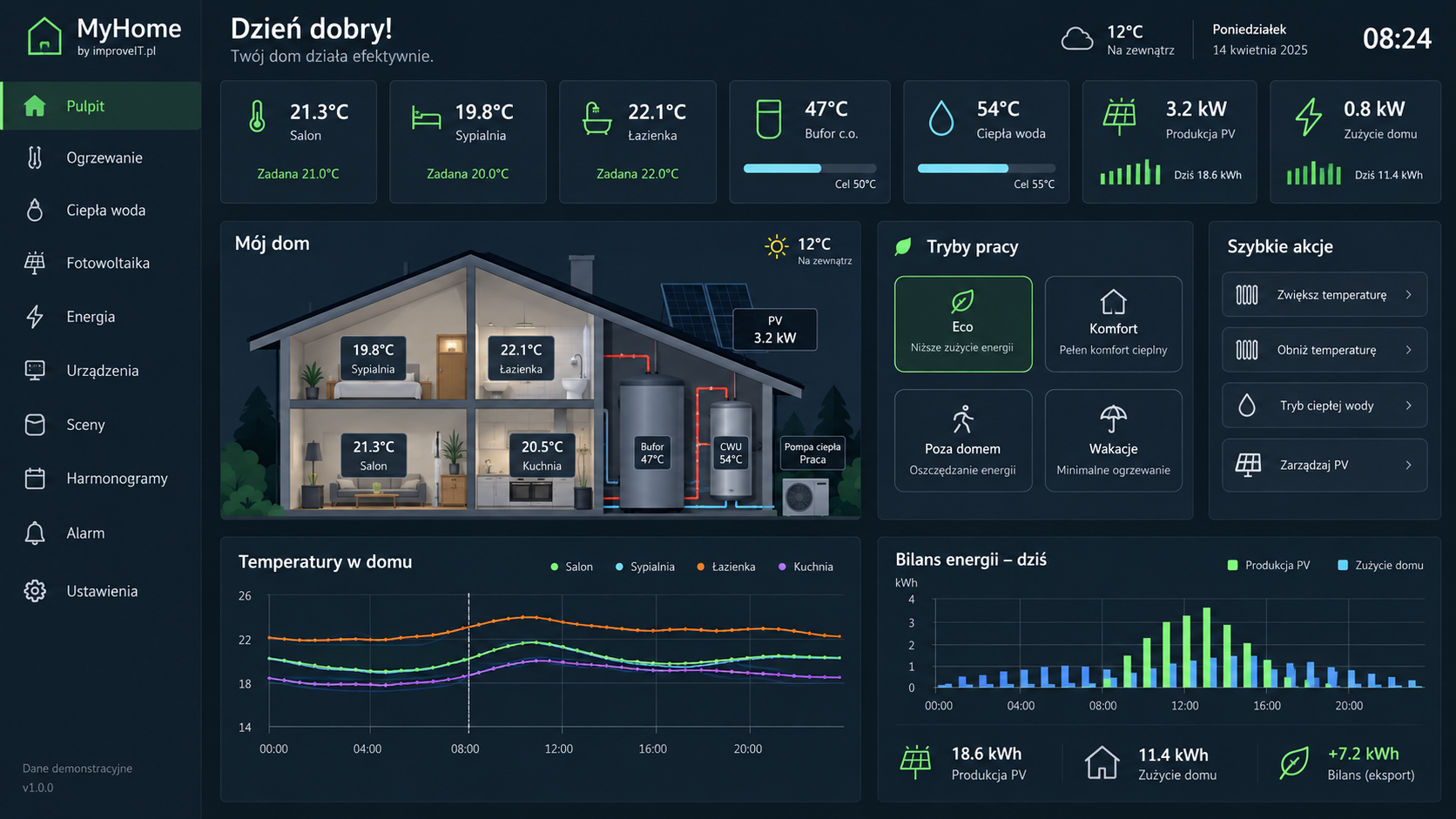
MyHome by improveIT.pl: a desktop and mobile product for managing home heating, hot water, devices and energy.
Readings are demonstration data; the mobile view is an illustrative adaptation of the desktop interface.
These scenarios illustrate what we can design for your product; they are not claims about completed deployments.
Job lists, issue photos, checklists, customer signatures and visit reports. Records can be saved offline and synchronized with CRM or ERP once connectivity returns.
User accounts, order history, points, coupons and status notifications. We connect commerce and payment services and design a clear purchasing flow.
Appointments, staff availability, reminders, payments and rescheduling. The backend controls availability to reduce duplicate bookings.
Lessons, audio materials, search and progress tracking. Selected content can be downloaded for offline use; an optional AI assistant works with an approved knowledge base.
We select the technology around product features, integrations and the expected development cadence.
Share a substantial part of the code between iOS and Android when workflows are similar. Native modules handle features requiring direct access to platform APIs.
Native development suits platform-specific APIs, demanding interfaces and deep hardware integration. Separate applications also require separate development and testing scope.
We agree on minimum OS versions, test devices and screen layouts. Camera, location and Bluetooth permissions are requested in the context of the feature that needs them.
Delivery covers the backend and compatibility with older app versions still installed on users’ devices.
We design authentication, roles, secure token storage and server-side access control. Data collection and analytics are agreed with the product owner.
We define offline operations, synchronization conflicts and notification content. AI is evaluated for quality, cost and whether processing belongs on the device or backend.
We prepare builds, beta testing, store materials and publication on client-owned accounts. We help address reviewer feedback; approval and timing depend on the store.
We monitor crashes within the agreed scope, maintain compatibility with OS updates and develop features based on user needs. We hand over source code and product documentation.
React Native and Flutter let us share much of the code. Each platform still needs configuration, testing and a separate release. Integrations and UX differences may require native code.
Yes, for agreed features such as forms, checklists and downloaded content. We design local storage, synchronization and conflict handling. Payments and operations requiring current server data need connectivity.
Yes. We help prepare releases on client-owned developer accounts. Accounts, store materials, privacy policies and required consents are agreed before launch. Approval remains the decision of App Store and Google Play.
Yes. We review code, backend services, account and certificate access, and crash reports before recommending stabilization, dependency updates and a release plan.